















 Spanish News Today
 Alicante Today
 Andalucia Today

Cribbage is the best traditional English card game for two players, and nothing else invented in England has held on as well. Five others deserve a place at the table: German Whist, All Fours, Put, Beggar-My-Neighbour and Costly Colours. Every one of them was invented or first recorded in England, and everyone needs nothing but a 52-card pack. Readers interested in exploring beyond this English selection can find further information about card and board games on gamerules.
That last point matters, because most “best two-player card games” lists quietly fill up with Gin Rummy, Pinochle and Egyptian Ratscrew, which are American, or with Bezique and Piquet, which are French. This piece uses a stricter test. A game qualifies if its earliest known description is English, which for four of the six means Charles Cotton’s The Compleat Gamester of 1674, the first serious English-language games compendium.
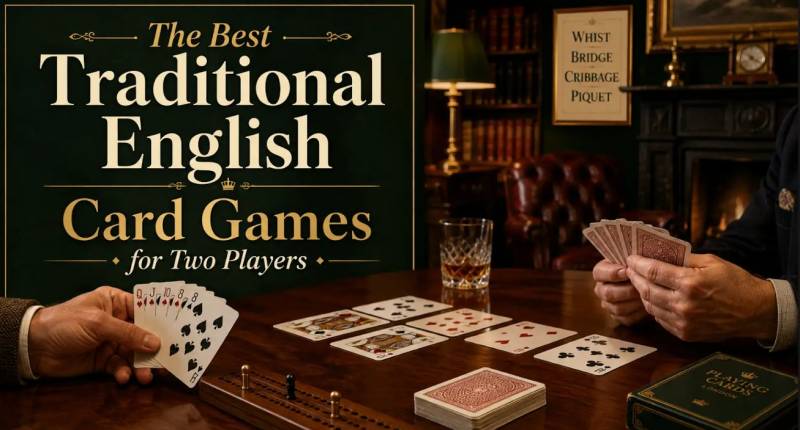
Cribbage is the only game on this list you can still walk into a pub and find a league for. Britannica puts the number of players in Great Britain at one to two million competing in nationwide leagues, plus a comparable number of casual players.
The structure explains the survival. Each player gets six cards and throws two into the crib, an extra hand that belongs to the dealer. You then peg cards alternately towards 31, scoring for pairs, runs and fifteens, before scoring your hand again at the show. The deal alternates, so the crib advantage evens out over a game to 121.
John Aubrey credited the invention to the poet Sir John Suckling in the early 17th century, as an improvement on the Tudor game of noddy, which the Oxford English Dictionary traces to 1589. Treat that attribution as tradition rather than fact. The OED's first citation of the word "cribbage" is 1630, which sits awkwardly with the story that Suckling invented it after 1632.
The older five-card version, in which each player is dealt five and keeps three, is still widely played in British pubs and leagues, and it is a faster, tighter game than the six-card standard most books teach.
German Whist has nothing to do with Germany. Card historians place it in Britain, and it is the game to reach for when two people want the deepest possible contest with no board, no counters and no second pack.
Each player is dealt 13 cards. The remaining 26 form a stock with the top card turned face up, and that card's suit is trumps for the whole hand. In the first stage you play tricks for the exposed card: the winner takes it, the loser takes the hidden card beneath. Thirteen tricks later the stock is gone and the second stage begins, and in the standard scoring only these last 13 tricks count.
The second half is where the game earns its reputation. By then both players have seen exactly half the pack go past, so a careful player can name all 13 cards in the opponent's hand and plan every trick to the end. The first half is a bidding war over cards you can see; the second is a calculation with no hidden information left.
All Fours gave English the word "jack". Before this game, the lowest court card was the knave, and the game's point for capturing the trump knave attached the name "jack" to the card itself.
Cotton described it in 1674 as a game much played in Kent, where he believed it originated. It was designed for two, and the name refers to its four scoring points: high, for holding the highest trump in play; low, for the lowest; jack, for winning the trump jack in a trick; and game, for the majority of card points, counted ten for a ten, four for an ace, three for a king, two for a queen and one for a jack. The target is seven points, which is why the game also travels as Seven Up.
It flourished as a gambling game in English pubs and taverns until the end of the 19th century, then found a second life abroad. Pitch, Pedro and Cinch all descend from it, and the original is now played more seriously in Trinidad and Tobago than in Kent.
Put is three cards each, no trumps, no obligation to follow suit, and a nerve test in the middle. The higher card wins the trick and a player who takes two of the three scores a point, with game at five.
The bluff is the mechanism. At any point a player may call "Put", which forces the opponent either to throw in the hand and concede a point, or to play on with the whole game point at stake. Cotton and Francis Willughby both recorded it in the early 1670s, using an odd card order in which the three is the highest card in the pack and the four the lowest.
Put died out during the 19th century, but not before feeding into Brag, and through Brag into the ancestry of poker. A deal takes under a minute, which makes it the best game here for two people with a short wait and a competitive streak.
Beggar-My-Neighbour is the outlier, because the players make no choices whatsoever. Split the pack, turn cards up alternately onto a central pile, and whenever someone turns a court card or an ace the opponent owes payment: four cards for an ace, three for a king, two for a queen, one for a jack. If a payment card turns up mid-payment, the debt reverses. Whoever collects the lot wins.
It has been documented in Britain since at least the 1840s and may be the same game as the "beat the knave out o' doors" mentioned in 1755. Dickens used it in Great Expectations in 1861, where it is the only game young Pip knows, and Estella mocks him during it for calling the knaves jacks, which is a neat historical joke given where the word came from.
The game also has a research paper. In 2024 a team led by Brayden Casella found a deal that never finishes, identifying a cycle of 62 tricks reachable from 30 distinct starting hands. That settled a question John Conway had filed among his "anti-Hilbert problems", and the American Mathematical Monthly published the result in 2025. No other game on this list can say that a hand of it runs forever.
Costly Colours is the one to learn if crib has gone stale. Cotton printed the rules in 1674 and they were reprinted in editions up to 1754, but by 1850 the game was being written off as obsolete. In the 19th century it was described as peculiar to Shropshire, and Charlotte Burne recorded a version from old players in her Shropshire Folklore of 1883.
Like cribbage it descends from noddy, and like cribbage it scores for combinations and for hitting totals in play. It drops the crib entirely, keeps noddy's original scoring scheme, and adds a longer list of combinations, which makes the counting harder and the hands more interesting. David Parlett's reconstruction is the practical source, and in the version most modern players use each player receives three cards and the target is 121.
Bezique and Piquet dominate the Victorian parlour scene and neither is English. Bezique is French, from bésigue, with its first published rules appearing in Paris in 1847 before it crossed the Channel and became fashionable enough that Winston Churchill made it his favourite game. Piquet is French and older still.
Gin Rummy is American and 20th century. Pinochle is the American descendant of Bezique. Whist is English, but the classic game needs four players in partnerships, which is why German Whist exists at all.
None of this makes the imports worse games. It does mean that a list of English two-handers that opens with Gin Rummy has not checked anything.
Yes, and with no cap on stakes or prizes, which no other card game gets.
Section 6 of the Gaming Act 1968 named dominoes and cribbage as the two games that could be played for money on licensed premises without further permission, which is where the familiar claim comes from. The Gambling Act 2005 repealed that section and replaced it with the exempt gaming regime in sections 279 and 280, so a pub can now host any equal-chance game without a licence, poker included.
What survived is the privilege rather than the monopoly. The Gambling Act 2005 (Exempt Gaming in Alcohol-Licensed Premises) Regulations 2007 cap stakes at £5 per person per game for every equal-chance game except dominoes and cribbage, and the Gambling Commission's code of practice repeats the exemption. Pub poker carries a further £100 aggregate daily stake limit and a £100 maximum prize. So the line you see repeated online, that cribbage is the only card game you can legally play for money in an English pub, was accurate under the 1968 Act and has been out of date since 2007.
Learn cribbage if you want a game that will still reward you in ten years, and buy a board, because pegging on paper removes half the pleasure. Learn German Whist if you want the hardest game available tonight with a pack you already own. Keep Beggar-My-Neighbour for playing with a child who cannot yet hold a fan of cards. Keep Put for the five minutes before the food arrives.
Costly Colours and All Fours are the two worth reviving deliberately, and both are better than their obscurity suggests. All Fours in particular is a strong two-player trick game that England exported and then forgot.
Which of these did your family actually play, and what house rules did they insist on?